Best USDT Casino Guide for Spanish Players in 2026: How Tether Deposits Work, Which Fees to Watch, and Where to Find a Trusted Crypto Casino
Best USDT Casino Guide for Spanish Players in 2026: How Tether Deposits Work, Which Fees to Watch, and Where to Find a Trusted Crypto Casino
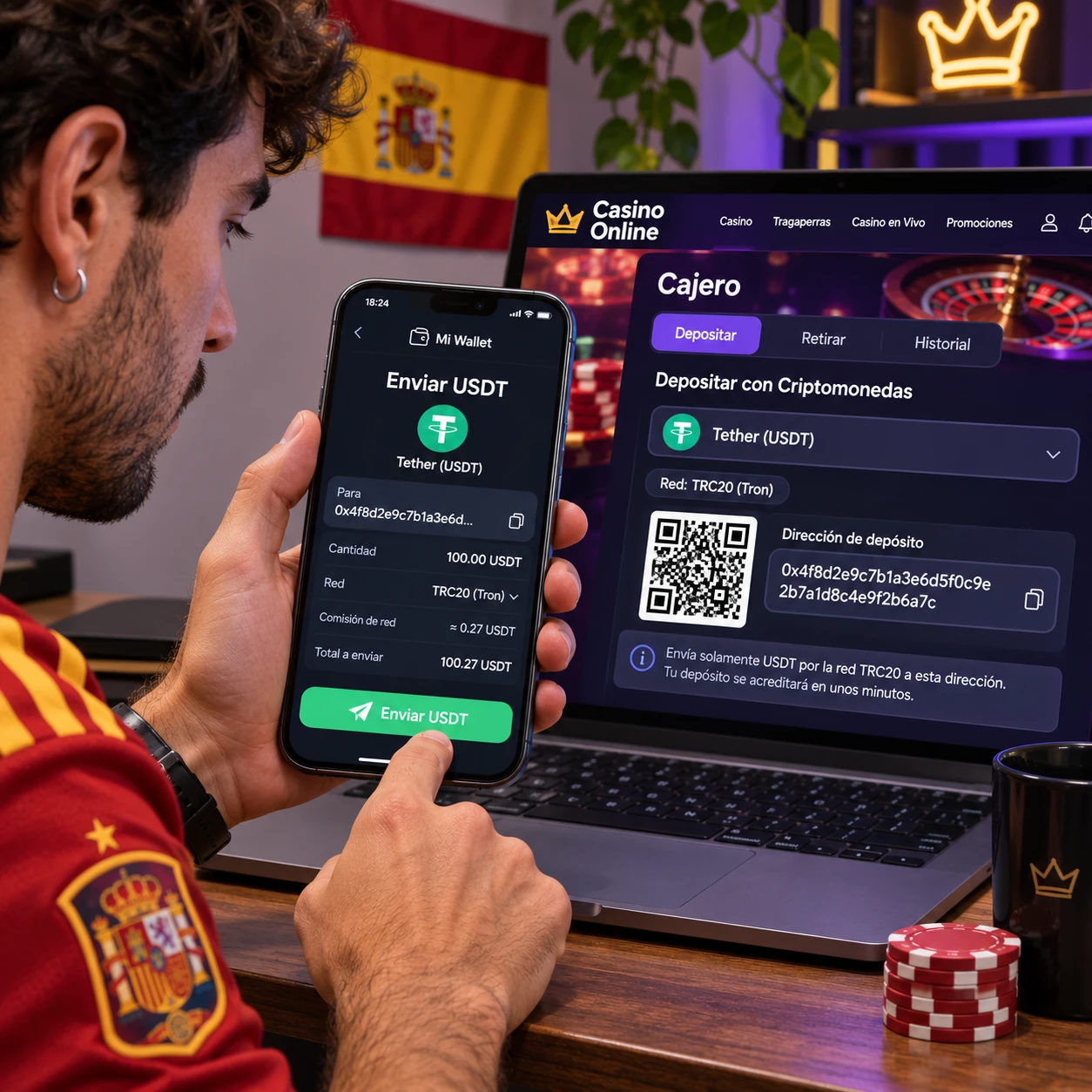
Something has shifted for Spanish players over the past year or so. Local banks tightened their gambling filters, card deposits bounce back declined with barely an explanation, and withdrawals that used to clear inside a day now sit in limbo long enough that you start wondering whether the money's coming back at all. I hear the same story from readers in Madrid, Valencia and Málaga. The games are fine. The payments are the problem.
That's where USDT comes in. Tether is a dollar-pegged stablecoin that hops between wallets in minutes — no card processor, no IBAN form, no bank clerk deciding your transfer looks suspicious. So let me walk you through how Tether deposits actually work, which fees quietly eat into your balance, how Spanish regulation applies to all of it, and how to tell a trustworthy operator from a lookalike that just copied a competitor's homepage. Get those four straight and moving money in and out stops being guesswork.
What a USDT Casino Actually Is — and Why Spanish Players Are Moving in 2026
A USDT casino is a betting site that settles deposits, withdrawals and often your whole account balance in Tether rather than euros. You aren't playing a different kind of game. You're using a different payment rail. Slots, live roulette, blackjack variants — the same ones you already recognise from Spanish-licensed sites. The difference sits behind the cashier window.
Three things drive the appeal. First, no card-decline friction: a blockchain transfer doesn't get blocked because a merchant category code reads as gambling. Second, near-instant settlement — a TRC-20 transfer typically confirms in under two minutes. Third, stable value. Sites that priced everything in bitcoin forced players to gamble on two things at once, their bet and the coin. Tether deletes that second wager. Which matters more than most people admit, right up until they've watched a balance drop 15% overnight for reasons that had nothing to do with the roulette wheel.
Tether (USDT) in Plain Terms
A stablecoin is a token built to hold a steady value, and USDT is pegged one-to-one to the US dollar — the issuer claims to hold matching reserves, and that claim is what keeps it trading at roughly €1 worth of dollars at any given moment. It isn't a currency you speculate on. It's a vehicle for moving dollar value across a network.
A wallet address is a string of characters that tells funds where to land. Here's the part people skip: you need a personal wallet — Trust Wallet, Exodus, a hardware device, whatever you prefer — not just an exchange account. If your USDT sits on an exchange, you're sending from an address the exchange controls, and you may have no way to pick the network, set your own fee, or claw back a misdirected transfer. Fund your own wallet first. Then deposit from it.
How USDT Casinos Differ From a Standard Spanish Online Casino
The contrast is clean. A standard Spanish operator hands you a euro account, IBAN transfers and a DGOJ licence with a complaints channel behind it. A crypto casino hands you a blockchain balance, wallet-based settlement and, often, a licence from Curaçao or Anjouan that's far harder to enforce from Spain. One side: speed, privacy, no banking friction. The other: weaker consumer recourse when something goes sideways.
I don't think one model is universally better. I do think players should choose knowingly, rather than drifting into the crypto model because a card payment failed once.
How Tether Deposits Work, Step by Step
Run through this once and the whole thing becomes routine:
- Create your account and complete whatever verification the operator requires up front.
- Open the cashier and select USDT as your deposit method.
- Choose the exact network the casino specifies — this is the step that matters most.
- Copy the deposit address shown, character for character.
- Open your personal wallet, paste the address, and send the amount.
- Wait for the required confirmations; TRC-20 usually needs one to three.
- Refresh the cashier and confirm the balance has credited before you play.
The single most common failure is sending on the wrong chain. Money sent to an address on a network the casino doesn't credit is, in practice, gone — the operator usually can't retrieve it and neither can you. Treat that address field like a bank account number. Not like a username.
Choosing the Right Network: TRC-20, ERC-20 and the Rest
USDT exists on several blockchains at the same time, and a casino only credits the one it names. For Spanish players the practical comparison looks like this: TRC-20 on Tron is typically the cheapest and fastest, often costing a fraction of a euro and confirming in a minute or two. ERC-20 on Ethereum is the most widely supported but fee-heavy, and congestion can push costs uncomfortably high on small deposits. Newer options — BEP-20 on BNB Chain, Solana, Polygon — are cheap and quick, but depend entirely on whether the operator supports them.
Check the cashier page before you send anything, not afterwards. If the deposit screen says TRC-20 only, that's the network you use, even when your wallet defaults to something else.
Timing, Confirmations and What 'Pending' Really Means
On-chain confirmation and casino crediting are two separate events. Your transaction can be final on the blockchain while the casino balance still shows nothing, because the platform waits for a set number of confirmations or runs its own crediting queue. Most deposits land inside two to ten minutes. Some sites batch-process and take noticeably longer.
If the stated confirmation count has passed and nothing appears, open a support ticket with the transaction hash (TXID) instead of firing off a second deposit. The hash is proof the transfer exists, and it lets support trace it without guesswork.
The Fees to Watch Before You Send a Single Tether
This is the section that most often saves money, because 'zero-fee deposits' marketing almost never tells the whole story. Three layers of cost sit between your euros and your balance. Only one of them belongs to the casino.
Three Layers of Cost — Network, Exchange Spread and Casino
Layer one is the blockchain. Network fees go to miners or validators, not to the operator, and you pay them whether the casino charges you or not. A €10 deposit on ERC-20 during congestion can lose a meaningful share of its value before it ever reaches the cashier.
Layer two is the spread. When you buy USDT with euros, your exchange or broker applies a commission and often a spread between the buy and sell price. Small purchases of a few hundred euros tend to get the worst rates, so compare before you convert.
Layer three is the casino itself — deposit fees, withdrawal fees and, on some sites, inactivity charges. These are the ones you can actually read in advance. So read them.
Withdrawal Minimums, Conversion Costs and the Small-Print Traps
A low withdrawal minimum looks generous until you pair it with a fixed network fee. Cashing out €15 when the transfer costs €2 in network fees and the site adds its own handling charge means you receive noticeably less than you won. Conversion is the second trap: if the platform converts your EUR balance to USDT at withdrawal, or applies its own exchange rate, the rate you get may sit well off the market.
Three clauses deserve a second read before you deposit anything: bonus wagering requirements attached specifically to crypto deposits, maximum cashout caps that silently limit what a bonus win is worth, and dormancy fees applied to accounts left untouched for a set period.
Is USDT Gambling Legal for Players in Spain?
Online gambling in Spain is regulated by the Dirección General de Ordenación del Juego (DGOJ), and any operator serving Spanish players legally must hold Spanish authorisation. Licensed sites also work under stricter payment-method rules than offshore crypto-only operators, which is exactly why plenty of them don't accept Tether at all.
The useful distinction is between 'legal to play at' and 'legal to operate from Spain.' A lot of crypto casinos accept Spanish players without holding a DGOJ licence; that's a regulatory position the operator took, not a guarantee of protection for you. Spanish law doesn't criminalise the player for using an offshore site, but you lose access to Spanish complaint mechanisms and dispute resolution the moment things go wrong. Verify licensing yourself rather than trusting a badge image in the footer.
Gambling is for adults only (18+). If gambling is costing you more than money, Spain's RGIAJ self-exclusion register and the Juego Seguro resources at the DGOJ let you block access to licensed operators, and organisations such as FEJAR can put you in touch with local support services. Set limits before you start, not after a bad night.
How to Identify a Trusted Crypto Casino in 2026
Design proves nothing. I've watched beautifully built sites vanish in eight months and plain-looking ones pay out reliably for years. What you can actually check: the named licence and its jurisdiction, provably fair mechanics or independently audited RNG, publicly documented deposit and withdrawal terms, withdrawal speeds reported by real users rather than affiliates, bonus conditions written in plain language, support that answers within a reasonable window, and a track record longer than a few months.
Apply those criteria consistently and most of the shortlist eliminates itself.
Red Flags That Should End the Search Immediately
- No licence stated anywhere, or a licence number that can't be verified.
- Withdrawal limits buried deep in the terms and conditions.
- Bonuses with wagering requirements so high they're mathematically unreachable.
- Support reachable only by email, with no live chat and slow replies.
- 'Guaranteed profit' or 'risk-free' claims of any kind.
- Demands for a deep stack of KYC documents before you've deposited anything.
Where to Start Your Shortlist
Rather than running that checklist from scratch across dozens of sites, you can start from a curated comparison of the best usdt casino options open to Spanish players and work backwards from there. Treat any list as a starting point, not a verdict. Check each candidate against the criteria above — licence, withdrawal terms, real user reports — before you send a single tether.
Common Mistakes Spanish Players Make With Tether Gambling
The same handful of errors come up again and again. Depositing before confirming network compatibility. Treating a bonus as free money without reading the wagering requirement stapled to it. Leaving a large balance on a casino account instead of a personal wallet you control. Skipping two-factor authentication on both the casino login and the wallet. And chasing losses, which crypto makes easier because a deposit feels less real than a bank transfer — there's no bank statement line waiting to confront you the next morning.
Set deposit limits before your first spin, and keep your gambling budget in euros in your head even while the balance reads in dollars.

Frequently Asked Questions
Do I need to verify identity to withdraw USDT?
Usually yes. Most reputable operators require KYC before a first withdrawal, and doing it early avoids a hold on your funds later.
Can I withdraw in euros instead of crypto?
Some sites offer fiat payouts, many don't. Where it exists, expect slower processing and a possible conversion cost.
What happens if I send USDT on the wrong network?
The funds typically become unrecoverable. Contact support with the transaction hash immediately, but treat recovery as unlikely.
Are USDT casino winnings taxable in Spain?
Spanish residents are generally expected to declare gambling winnings as income. Crypto holdings carry their own reporting obligations, so speak to a Spanish tax adviser about your specific situation.
How long do withdrawals usually take?
Once approved, a crypto payout often arrives in minutes. Approval itself can take anywhere from a few minutes to 24 hours depending on the operator's checks.
Is a VPN needed for Spanish players?
Not for access, but some sites geo-block Spain. Using a VPN to bypass a block puts your account and balance at risk of closure — better to pick an operator that accepts Spanish players openly.
Final Thoughts
Three decisions carry almost all the weight: choose an operator you can actually verify, confirm the network before every single transfer, and understand the full fee stack before you work out your bankroll. Get those right and the payment side of crypto gambling becomes genuinely convenient instead of a source of quiet losses.
USDT removes payment friction. It doesn't remove risk — not market risk, not operator risk, and certainly not the risk that comes with playing beyond your limits. Keep balances small, keep records, and stop when the number stops being fun.
18+. Gambling can be addictive. Play responsibly, set limits before you start, and visit the RGIAJ self-exclusion register or Juego Seguro if you need support.